Key takeaways
- Digital marketing is legit. Google search, maps, ads and websites are where most customers look for local services today.
- Scams are real too. The most common are guaranteed #1 rankings, fake leads, bought followers and agencies that keep your accounts.
- Results come from tracking. A legit agency shows you calls, leads and booked jobs, not just clicks and impressions.
- You should always own your accounts. Your website, domain, Google Business Profile and ad accounts belong in your name.
- Nobody can guarantee a #1 ranking on Google. Google says so itself.
In this guide
- Is digital marketing legit?
- Why so many people think digital marketing is a scam
- 7 common digital marketing scams (and how to spot them)
- Is digital marketing worth it for a small business?
- How to check if a digital marketing agency is legit
- What about digital marketing courses and “make money online” offers?
- FAQs
Is digital marketing legit?
Yes, digital marketing is legit. It means promoting your business where customers already look for help: Google search, Google Maps, social media, websites and email. Done well, it brings in real calls and customers you can track. The scams come from some of the people selling it, not from digital marketing itself. Think about how your own customers find you. When a homeowner’s water heater fails, they don’t open the phone book. They search “water heater repair near me” and call one of the first companies they see. Showing up in that moment is digital marketing, and it is the reason the businesses at the top of Google stay busy. The problem is that digital marketing is easy to sell and hard for a busy owner to check. That gap is where scammers live. Written by Ghulam Dastgeer, Founder of BlueCyde · Updated November 8, 2026Why so many people think digital marketing is a scam
If you’ve ever wondered “is digital marketing a scam?”, you’re not alone. Most owners who feel burned by marketing had one of these experiences:- Big promises, no proof. They were promised “page one in 30 days” or “10x leads,” and nothing changed.
- Reports that don’t mean anything. Monthly reports were full of impressions, reach and clicks, but never showed calls, leads or sales.
- No access to their own accounts. The agency set up the website, Google Ads account or Business Profile under its own name, so the owner couldn’t see what was happening or take it with them.
- Long contracts with no way out. A 12-month contract locked them in long after it was clear the work wasn’t paying off.
- Too many vendors, no one accountable. A web designer, an SEO company and an ads freelancer each blamed the others when results didn’t come.
7 common digital marketing scams (and how to spot them)
Most digital marketing scams follow the same few patterns. Once you know them, they are easy to spot.1. The guaranteed #1 ranking
“We guarantee you’ll be #1 on Google.” No one can promise that, because no one controls Google’s results. Google says it plainly in its guide Do You Need an SEO?: “No one can guarantee a #1 ranking on Google.” So, is SEO a scam? No. But an SEO company that guarantees rankings is a red flag.2. The fake “Google” phone call
A caller says your Google listing “will be suspended” or “needs to be verified,” then asks for a fee or your login details. Google warns business owners about these calls on its page Help protect against fraudulent calls and texts. It says Google will never ask for private or sensitive information and will never guarantee you a special spot in its products. If someone calls claiming to be Google, hang up and check your Business Profile yourself.3. Fake or recycled leads
Some lead-generation companies sell the same lead to five businesses, or pad their numbers with fake forms. If most “leads” never answer, have wrong numbers or are already working with a competitor, you are not getting real leads.4. Bought followers and likes
Thousands of new followers look impressive in a report. But if they are bots or accounts from other countries, they will never hire you. Watch for big follower jumps with no change in calls or messages.5. Accounts held hostage
The agency builds your website, Google Ads account or Business Profile under its own login. When you leave, it keeps the account, the data and sometimes even your domain. A legit agency sets everything up in your name and gives you admin access from day one.6. Hidden markup on ad spend
You think $2,000 a month is going to Google Ads, but only $1,200 is. The rest quietly goes to the agency. Ask to see the ad account and the billing directly. Your card should pay Google, and the agency fee should be a separate line.7. Long contracts with no exit
A short minimum term is normal, because ads and SEO need time to learn. But a 12-month or 24-month contract with no way out, before you have seen any results, protects the agency, not you.Scam vs. legit: quick comparison
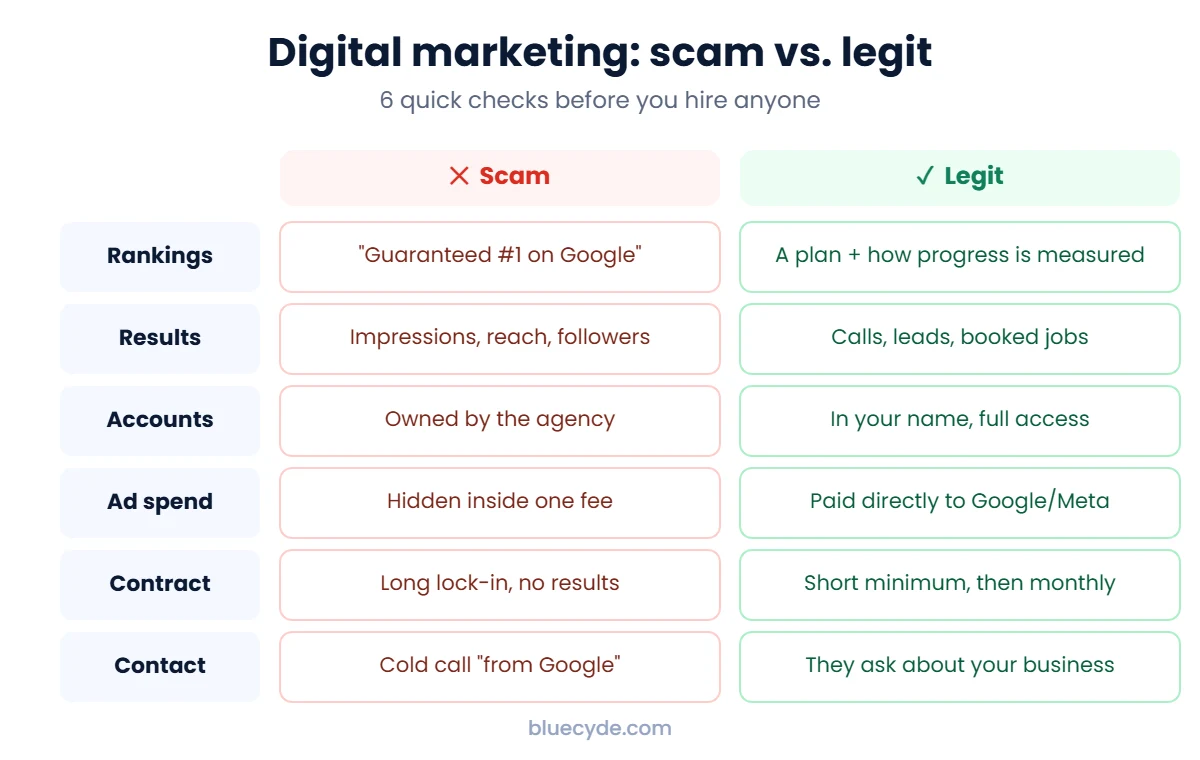
| What you hear | Scam version | Legit version |
|---|---|---|
| Rankings | “Guaranteed #1 on Google” | “Here’s our plan and how we’ll measure progress” |
| Results | Impressions, reach and followers | Calls, leads, booked jobs and cost per job |
| Accounts | Set up under the agency’s name | Set up in your name, with full access for you |
| Ad spend | Hidden inside one big fee | Paid directly to Google or Meta from your card |
| Contract | Long lock-in before any results | Short minimum, then month to month |
| Contact | Cold call “from Google” | You reach out, and they ask about your business |
Is digital marketing worth it for a small business?
For most local service businesses, yes, digital marketing is worth it, as long as three things are true:- You can handle more work. More leads only help if you have the people and time to serve them.
- You track results. Every call and form should be tied back to where it came from, so you know what is paying off.
- You give it enough time. Paid ads can work in weeks, but SEO builds over months.
Is Google Ads worth it?
Google Ads is often the fastest way for a service business to get calls, because your ad shows at the top of Google the moment someone searches. It is worth it when the account is set up carefully: tight local targeting, the right keywords, “negative keywords” to block bad searches like “plumbing jobs,” and call tracking so you can see your real cost per lead. For many home service businesses, Google’s Local Services Ads are worth testing too, because you pay per lead instead of per click. See how we handle Google Ads and Local Services Ads. Where Google Ads wastes money is when no one watches it: broad targeting, no tracking and no one cutting the searches that never turn into customers.Is SEO worth it?
SEO is slower, but it compounds. Once your website and Google Business Profile rank for searches like “AC repair near me,” those calls keep coming without paying for every click. For local businesses, the biggest wins usually come from local SEO: a complete Business Profile, steady reviews and a clear page for each service you offer. New to SEO? Read our guide to what SEO is in digital marketing, or see our local SEO services. The best setup for most owners is both: ads for calls now, SEO for cheaper calls later.How to check if a digital marketing agency is legit
Before you sign with any agency, run through this checklist. A legit agency will be happy to answer every question.- Ask who will own the accounts. The answer should be “you.” Your domain, website, Google Business Profile and ad accounts stay in your name.
- Ask to see a sample report. Look for calls, leads, booked jobs and cost per lead. If it only shows impressions and clicks, keep looking.
- Ask how ad spend is billed. Ideally, Google and Meta charge your card directly, and the agency fee is separate.
- Ask for examples from businesses like yours. Experience in your trade and your type of market matters.
- Ask how they get results. They should explain their methods in plain English and follow Google Search Essentials. Be careful with anyone who is vague or secretive.
- Read the contract. A short minimum term is fine. A long lock-in before any results is not.
- Check reviews and talk to a past client. Ask whether the agency was easy to work with and whether results showed up in real calls.
- Notice what they ask you. A good agency asks about your capacity, your best jobs and your service area before it talks about price.
What about digital marketing courses and “make money online” offers?
Some people searching “is digital marketing legit” aren’t business owners. They saw an ad promising they could “make six figures from home” with a digital marketing course. That is a different question, and it deserves an honest answer. Digital marketing is a real skill and a real career. But many “get rich” courses and coaching programs sell the dream, not the skill. The U.S. Federal Trade Commission lists the warning signs in its guide When a Business Offer or Coaching Program Is a Scam. They include:- Promises of guaranteed income or huge returns
- Pressure to sign up right now before you “miss out”
- Upsells to more expensive programs after you’ve paid
- More focus on recruiting other people than on teaching a real skill
Frequently asked questions
Is digital marketing a scam?
No. Digital marketing is a real and widely used way to reach customers on Google, maps, social media and websites. Some people and companies in the industry use scam tactics, such as guaranteed rankings or fake leads, so it pays to check any agency before you hire it.
Is SEO a scam?
SEO itself is not a scam. It is the work of improving your website and online presence so you rank in Google’s free results. But any SEO company that guarantees a #1 ranking is making a promise no one can keep.
Is digital marketing worth it for a small business?
It is usually worth it when you can take on more work, track where your calls come from and give campaigns a few months. Paid ads bring faster results, while SEO builds over time.
How do I know if a marketing agency is legit?
A legit agency keeps your accounts in your name, reports on calls and leads rather than vanity numbers, bills ad spend transparently, explains its methods and offers fair contract terms.
Does Google call businesses to improve their ranking?
Google says it will never guarantee you a special spot in its products and will never ask for private or sensitive information on a call. If a caller claims your listing will be suspended unless you pay, treat it as a scam.