It’s 11 p.m. in July, and a homeowner’s AC just quit. They grab their phone and type “AC repair near me.” Within seconds, they call one of the first three companies they see. If your business isn’t one of them, that job goes to a competitor. That’s why so many contractors ask: what is SEO in digital marketing, and does it actually bring in calls?
In digital marketing, SEO is the work that helps your business show up in Google’s free results when local customers search for your services. In this guide, you’ll learn what SEO means in plain English, how search engines decide who ranks, the core SEO principles that matter for service businesses, and a real-world SEO example from an HVAC company. You’ll also see how SEO compares with paid ads, so you can decide where to start.
Key takeaways
- SEO stands for search engine optimization: improving your site so it ranks in Google’s free results.
- Google ranks pages in three steps: crawl, index, rank.
- Four principles drive rankings: relevance, quality, trust and experience.
- There are three types of SEO: on-page, technical and off-page. For contractors, local SEO and the map pack matter most.
- SEO vs. PPC: ads bring fast calls, SEO brings lower-cost leads over time. Most contractors need both.
What is SEO in digital marketing?
SEO (search engine optimization) is the process of improving your website and online presence so it ranks higher in Google’s free, organic results. For a contractor, good SEO means showing up when homeowners in your service area search for the work you do, such as “emergency plumber” or “roof repair near me.”
Unlike paid ads, you don’t pay for each click. You earn your spot by having the most helpful, trustworthy and relevant pages for the search. Once you rank, that visibility keeps bringing in leads month after month. That is the core of home service SEO.
Written by Ghulam Dastgeer, Founder of BlueCyde · Updated November 7, 2026
What does SEO mean in marketing?
SEO is the abbreviation for search engine optimization. In marketing, it means getting your business in front of people at the exact moment they’re looking for what you sell, without paying for every visit.
So, what is SEO marketing in practice? It’s treating your website, your Google Business Profile and your online reputation as a lead-generation channel. Instead of interrupting people with ads, you show up as the answer when they search.
Organic vs. paid results: what’s the difference?
When someone searches on Google, they usually see three kinds of results:
- Paid ads. Marked “Sponsored.” Businesses pay each time someone clicks.
- The map pack. The three local businesses shown with a map. These are free and earned through local SEO.
- Organic results. The regular blue links below. These are also free and earned through SEO.
Ads stop the moment you stop paying. Organic and map pack rankings keep working, which is why SEO is often the lowest-cost lead source over the long run.
How search engine optimization works
Search engine optimization works by helping Google find your pages, understand them and trust them enough to show them to searchers. Your search engine positioning, meaning where you appear on the page, depends on how well you do each step.
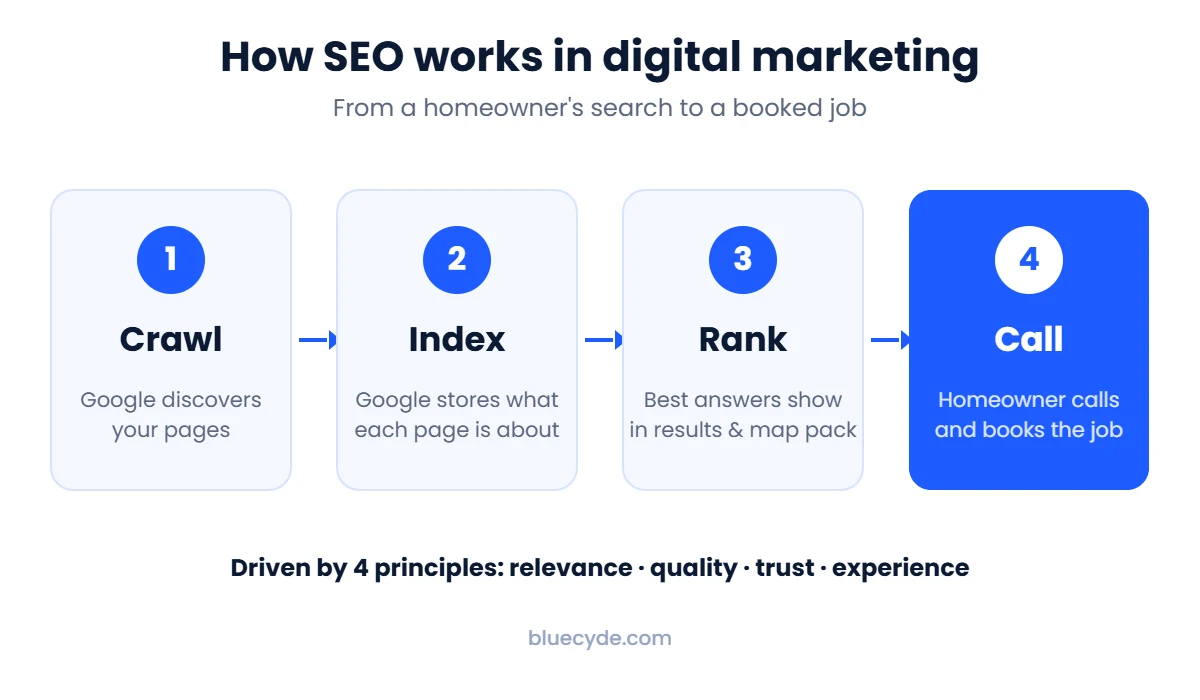
Crawl, index, rank
- Crawl. Google’s bots follow links across the web and discover your pages.
- Index. Google reads each page and stores what it’s about, such as “furnace repair in Denver.”
- Rank. When someone searches, Google picks the pages it thinks best answer that search and orders them.
Google explains this process in its own guide, How Google Search Works.
The 4 core SEO principles
Almost every SEO best practice comes back to four principles:
- Relevance. Your page clearly answers what the person searched. A “water heater installation” page should talk about water heater installation, not your whole company history.
- Quality. Your content is helpful, original and written for people, not just for search engines.
- Trust. Google looks for signs that you’re a real, reputable business: reviews, links from other sites, consistent contact details and real expertise.
- Experience. Your site loads fast, works well on phones and makes it easy to call or book.
These line up with Google Search Essentials, the official rules every site should follow.
The 3 types of SEO for service businesses
SEO is usually split into three parts. You need all three working together to rank well.
On-page SEO
On-page SEO is everything on the page itself: the title, headings, text, images and internal links. For a contractor, that means a separate page for each core service, such as AC repair, furnace installation or drain cleaning, each written for the people searching for it. An SEO-friendly website also makes the next step obvious, with click-to-call buttons and simple booking. Learn more about on-page SEO or how we build contractor websites.
Technical SEO
Technical SEO makes sure Google can crawl and index your site without problems. It covers site speed, mobile-friendliness, secure HTTPS, clean URLs, sitemaps and fixing broken links. A slow site or blocked pages can hold back even the best content. See our technical SEO service.
Off-page SEO
Off-page SEO is what happens outside your website that builds trust: links from other reputable sites, mentions of your business, and online reviews. A link from your local supplier, chamber of commerce or a trade association tells Google you’re a real, established business. Read more about off-page SEO.
What is local SEO in digital marketing?
Local SEO is the part of SEO that helps you rank for searches in a specific area, such as “plumber in Tampa” or “roofer near me.” For home service companies, it’s often the most important part, because your customers are within your service area and need help now.
The main prize in local SEO is the map pack: the three businesses Google shows next to a map, above most organic results. For a step-by-step plan, see our local SEO checklist for contractors.
Google Business Profile
Your Google Business Profile is the listing that appears in the map pack and on Google Maps. To give it the best chance to rank:
- Choose the most accurate primary category, such as “HVAC contractor.”
- Add your service area, hours, services and real photos of your team and work.
- Keep your business name, address and phone number exactly the same everywhere.
- Post updates and answer customer questions.
Always follow Google’s Business Profile guidelines. Breaking them, for example by stuffing keywords into your business name, can get your profile suspended.
Reviews and local directories
Reviews are one of the strongest local ranking signals, and they’re what convince a homeowner to call you instead of the next company. Ask every happy customer for a review, and reply to all of them, good or bad.
Listings on trusted business directories, such as Yelp, Angi, the BBB and your local chamber of commerce, also help. These citations confirm to Google that your business is real and where you say it is. Want help with this? See our local SEO services.
An SEO example: how an HVAC company gets found
Here’s a simple, illustrative SEO example that shows how the pieces fit together. Picture an HVAC company in Phoenix during the first heat wave of summer.
- The search. A homeowner’s AC stops cooling, and they search “AC repair near me” on their phone.
- The map pack. Google shows three local companies. This one appears because its Google Business Profile is complete, its service area covers the homeowner’s neighborhood, and it has a steady stream of recent reviews. (Local SEO and trust.)
- The click. The homeowner taps the website link and lands on a dedicated “AC Repair in Phoenix” page, not a generic homepage. It explains the service clearly and answers common questions. (On-page SEO and relevance.)
- The experience. The page loads in about a second on mobile and has a large “Call Now” button at the top. (Technical SEO and experience.)
- The call. The homeowner taps to call, and the office books a same-day visit.
No single tactic won that job. Every step depended on one of the SEO principles above. That’s what good SEO for HVAC companies looks like: a whole system that turns a search into a booked call. The same approach works for plumbers and roofers. If you run an HVAC business, see how we approach HVAC marketing.
SEO vs. PPC: which should a contractor start with?
PPC (pay-per-click) means paid ads, such as Google Ads and Local Services Ads, where you pay when someone clicks or calls. You may also hear the term SEM (search engine marketing). It usually refers to paid search ads, and sometimes to paid ads and SEO together.
| SEO | PPC (Google Ads, LSA) | |
|---|---|---|
| Speed | Builds over several months | Calls can start within days or weeks |
| Cost | Monthly work, but no cost per click | You pay for every click or lead |
| How long it lasts | Rankings keep working over time | Leads stop when the budget stops |
| Best for | Long-term, lower-cost leads | Fast results and busy seasons |
For most home service companies, the honest answer is both. Paid ads get the phone ringing quickly while SEO builds a steady flow of free leads that lowers your cost per job over time. Learn more about our PPC management, Google Ads and Google Local Services Ads services.
How long does SEO take, and what does it cost?
SEO is a long-term investment. Most businesses start to see meaningful movement over several months, and results keep compounding after that. How fast depends on your market, your competitors and where your site starts. Be wary of anyone who guarantees a #1 ranking: Google itself says no one can promise that.
Cost depends on how many services and locations you need to rank for and how much work your site and profile need. For a full breakdown, see our FAQs on SEO cost and pricing.
Frequently asked questions
What is the main goal of SEO in digital marketing?
The main goal of SEO in digital marketing is to bring qualified visitors to your website from search engines without paying for each click. For a contractor, the real goal is more calls and booked jobs from people already looking for your services.
Is SEO still worth it with AI search?
Yes. AI tools like Google’s AI Overviews and ChatGPT pull their answers from websites they trust. The same things that help you rank on Google, such as clear answers, real expertise and a strong reputation, also make you more likely to be mentioned in AI answers.
Can I do SEO for my business myself?
You can handle the basics yourself: complete your Google Business Profile, ask for reviews and create a clear page for each service. As your market gets more competitive, technical fixes, content and link building take more time and skill, which is when many owners bring in help.
Does SEO work for a small, one-truck business?
Yes. Local SEO is one of the best fits for small service businesses, because you only need to beat the other companies in your service area, not the whole country.
The bottom line
So, what is SEO in digital marketing? It’s how your business becomes the one homeowners find, trust and call when they need help. Get the four principles right, cover on-page, technical, off-page and local SEO, and your website can become one of your most reliable sources of booked jobs.
Not sure where your business stands today? Get a free growth audit. We’ll review your Google ranking, reviews, website and ads, and show you the top three fixes to win more calls. You can also explore all our digital marketing services for home service companies.