
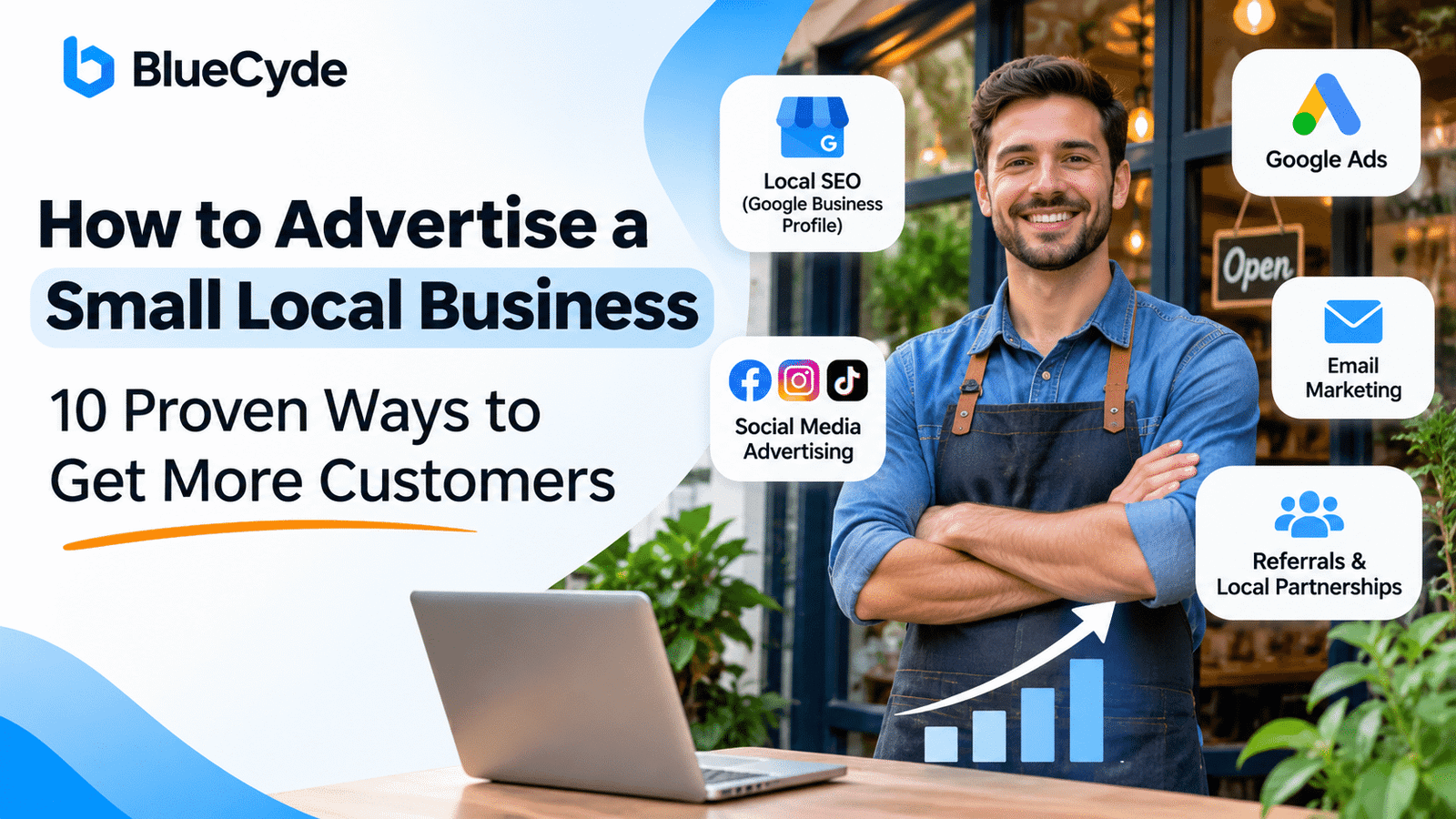
Local Business Advertising
Be visible where nearby customers are looking.
Local SEO • Google Ads • Social Media • Reviews • Referrals
Key Takeaways
- Define your ideal local customer, service area, and main business goal.
- Build a reliable foundation with a useful website and accurate Google Business Profile.
- Use local SEO, paid search, social media, reviews, referrals, and community partnerships where they fit.
- Track calls, enquiries, bookings, qualified leads, and sales—not just views or likes.
- Start with a manageable budget, test channels, and invest more in what produces profitable customers.
Start with a Clear Local Advertising Plan
Before spending money on promotion, decide who you want to reach and what you want them to do. If you are working out how to advertise a small local business, begin with a clear audience, a realistic service area, and one measurable goal. A neighborhood restaurant may want more reservations and walk-in visits. A plumber may need calls from homeowners in specific neighborhoods. A salon may want appointment bookings during quieter days.
That is the starting point for understanding how to advertise a small local business: choose a measurable goal, identify the people most likely to become customers, and focus on locations you can realistically serve. A practical local business marketing plan connects each promotion to a specific audience, service, and next step.
Define your customer and service area
Describe your best-fit customer, the problem they need solved, and the locations you serve. This first step makes it easier to decide how to advertise a small local business without wasting money on people outside your market. Avoid advertising across a large region if your team can only serve a few nearby areas. For service-area businesses, clearly communicate the places you actually cover.
Choose one primary outcome
Pick a priority such as phone calls, quote requests, bookings, store visits, or online orders. A specific outcome keeps your plan focused when deciding how to advertise a small local business across several channels. One clear primary goal makes it easier to compare channels and make budget decisions.
Build Your Local Online Foundation First
Advertising works better when people can quickly verify your business and understand how to contact you. This foundation is essential when learning how to advertise a small local business because every campaign should lead customers to trustworthy, useful information. Before launching campaigns, check these essentials:
- Website: Explain your services, locations, opening hours, and next step. Make it easy to call, book, or request a quote on mobile.
- Google Business Profile: Claim and verify your profile if eligible. Keep your name, address or service area, phone number, hours, categories, and services accurate. Google's local ranking guidance explains the role of relevance, distance, and prominence.
- Consistent business details: Use accurate business information across important directories and profiles.
- Trust signals: Show genuine reviews, clear service information, real photos, and straightforward contact details.
- Tracking: Set up suitable analytics and conversion tracking to understand which campaigns generate calls, forms, and bookings.
A strong local SEO foundation can support long-term discovery. Explore BlueCyde's local SEO services and technical SEO services.
10 Ways to Advertise a Small Local Business
These small business advertising ideas combine online visibility with community-based promotion. The best approach to how to advertise a small local business is rarely one platform alone; it is a practical mix of channels your customers already use. Choose the options that match how your customers discover and compare local providers.
There is no single channel that works for every business. The best approach depends on what you sell, how customers make decisions, your competition, and your budget. Consider these options and test the ones that fit.
1. Optimize Your Google Business Profile
For owners researching how to advertise a small local business, a complete Google Business Profile is a strong starting point. It can help eligible local businesses appear in Google Search and Maps when people look for relevant products or services nearby. Add accurate categories, services, hours, contact details, and useful photos. Respond professionally to customer reviews and keep information current.
Do not add misleading locations, use fake reviews, or stuff keywords into your business name. Follow Google's profile guidelines.
2. Invest in Local SEO
For companies researching local SEO for small business growth, the priority is to make accurate, useful information easy for nearby customers to find. It is also one of the most sustainable ways to advertise a small local business because useful local pages can attract relevant searches over time.
Local SEO helps your business become easier to discover for relevant searches in the areas you serve. Create useful service pages, explain coverage areas honestly, answer customer questions, improve mobile usability, and make contact details easy to find.
For example, a roofing company might create a clear roofing services page and supporting location pages only where it genuinely operates and can provide distinct, useful information. Avoid publishing near-identical city pages with little value.
3. Run Targeted Google Search Ads
When deciding how to advertise a small local business quickly, Google Ads can put your business in front of people searching for a service or product you offer. Start with high-intent searches, relevant ad groups, clear landing pages, and geographic settings that match your service area. Use negative keywords to reduce irrelevant clicks and review search terms regularly.
Track calls, forms, purchases, or bookings where possible. A campaign that generates clicks but no qualified enquiries needs investigation. Learn more about BlueCyde PPC management.
4. Use Facebook and Instagram Advertising
As part of a plan for how to advertise a small local business, Meta advertising can help local businesses introduce products, show their work, promote seasonal offers, and reach audiences in selected locations. Use real photos or videos, a clear offer, and one direct call to action: call, message, book, visit a website, or request a quote.
Test a small number of creative variations. Monitor lead quality and actual bookings, not only reactions or comments.
5. Publish Helpful Social Media Content
These activities are also practical ways to advertise a small business without relying entirely on paid campaigns. They are useful options when considering how to advertise a small local business on a limited budget.
Organic social media can keep your business visible and help potential customers understand what makes it useful. Share practical tips, product demonstrations, behind-the-scenes moments, staff introductions, customer questions, project examples, and genuine updates.
Choose platforms your customers actually use. A local visual business may benefit from Instagram, while a professional service may find LinkedIn more relevant. A realistic schedule is better than posting frequently without a purpose.
6. Ask for Genuine Customer Reviews
Reviews help potential customers evaluate a business. They also support a wider strategy for how to advertise a small local business by building confidence before someone calls or visits. After a completed job or purchase, invite customers to share honest feedback through a neutral request. Make your review link easy to find, respond politely to feedback, and use recurring comments to improve service.
Never buy reviews, pressure customers to leave only positive feedback, or offer incentives in ways prohibited by a platform. Check review policies first.
7. Build a Referral Program
Word-of-mouth can be valuable because local customers often ask friends, relatives, and colleagues for recommendations. For some owners, this is one of the most cost-effective answers to how to advertise a small local business. Encourage satisfied customers to refer people who may genuinely need your service. If you offer a referral reward, make the terms clear and check relevant rules.
Keep the process simple: explain who qualifies, how the referral is recorded, and when any reward is provided. Track referred enquiries and completed sales.
8. Partner with Other Local Businesses
Partnerships can extend your reach when deciding how to advertise a small local business. Look for businesses that serve a similar audience without directly competing with you. A wedding photographer might build relationships with venues and florists. A home cleaning company might connect with property managers or moving companies.
Partnerships can include cross-promotions, useful joint events, referral arrangements, or shared educational content. Agree on responsibilities and make sure each audience receives a relevant benefit.
9. Use Email and SMS for Customer Retention
Email and SMS can support repeat business as part of a plan for how to advertise a small local business. With appropriate permission and in line with applicable privacy and marketing laws, use email or SMS to stay in touch. Send appointment reminders, service updates, seasonal advice, loyalty messages, or relevant offers. Segment your audience so customers receive messages that make sense for their relationship with your business.
Identify your business clearly, respect opt-outs, and avoid excessive messages. Communication should remain useful and expected.
10. Try Local Events, Sponsorships, and Print Advertising
Offline promotion can still make sense when it reaches the right neighborhood audience. It can complement digital channels when deciding how to advertise a small local business in a specific community. Consider community events, local fairs, relevant sponsorships, flyers, direct mail, local publications, or signage. Include a trackable phone number, QR code, landing page, or campaign code where practical.
Choose placements based on audience fit rather than reach alone. A small relevant community event may be more useful than a broad campaign reaching people outside your service area.
How Much Should a Small Business Spend on Advertising?
When comparing local business advertising options, assess both the direct campaign cost and the time required to manage each channel. The right budget depends on how to advertise a small local business in a way that can be measured and sustained.
There is no universal advertising budget for every small business. The right amount depends on margins, cash flow, customer value, competition, growth targets, and how reliably the business can serve new demand.
Separate your budget into two categories:
- Marketing foundations: Website improvements, photography, tracking, profile setup, and essential creative assets.
- Campaign spend: Money paid to advertising platforms, publishers, event organizers, or print providers.
Start with an amount the business can afford to test without putting essential operations at risk. Run a focused campaign long enough to gather meaningful data, check lead quality, and calculate the cost of acquiring a paying customer. Increase spend gradually only when the business can handle more enquiries and the economics make sense.
Remember that platform spend is not the only cost. Creative production, staff time, landing pages, call handling, and follow-up also affect the total investment.
Which Advertising Channels Should You Choose?
Good local advertising strategies balance customer intent, available budget, and the time your team can commit to consistent execution. That balance is central to choosing how to advertise a small local business effectively.
Use this table as a starting point. It is not a guarantee of results; validate each option against your customers and local market.
| Business type or goal | Channels to consider | Useful first measure |
|---|---|---|
| Plumber, electrician, HVAC, roofer | Google Business Profile, local SEO, search ads, reviews | Qualified calls and booked jobs |
| Restaurant or café | Maps visibility, social content, local partnerships, local ads | Reservations, visits, orders |
| Salon or beauty service | Local SEO, Instagram, reviews, booking reminders | Appointments and repeat bookings |
| Retail shop | Local search, social ads, email, events | Store visits and sales |
| Professional services | SEO, helpful content, search ads, referrals, LinkedIn | Qualified consultations and signed clients |
Common Local Advertising Mistakes to Avoid
- Trying every platform at once: Start with channels that match your audience and goal.
- Targeting too wide an area: Focus on locations you can actually serve.
- Sending traffic to a weak website: Make sure the page answers questions and makes contacting you easy.
- Ignoring calls and enquiries: Respond promptly and have a clear follow-up process.
- Measuring likes instead of customers: Connect reports to qualified enquiries, appointments, and sales.
- Stopping too early or never reviewing: Give tests enough time to produce useful data, then make evidence-based changes.
- Using misleading claims or fake reviews: Keep advertising truthful and follow platform policies and applicable laws.
How to Measure Local Advertising Results
To understand whether your approach to how to advertise a small local business is working, set up a simple monthly report that connects marketing activity to business outcomes. Useful measures include:
- Enquiry volume: Calls, contact forms, messages, bookings, and quote requests.
- Lead quality: The share of enquiries that match your service, location, and customer criteria.
- Conversion rate: The percentage of relevant enquiries that become paying customers.
- Cost per lead: Campaign cost divided by leads generated, using consistent tracking.
- Customer acquisition cost: The total attributable marketing and sales cost required to acquire a customer.
- Revenue and profit contribution: Sales and margin generated by the campaign, where tracking allows.
Use call tracking or campaign-specific landing pages where appropriate, ask new customers how they heard about you, and keep records in a simple CRM or spreadsheet. Avoid counting every click or call as a qualified lead. Measurement should help you learn which activities bring customers who are valuable to the business.
Need a Better Local Marketing Plan?
If you are deciding how to advertise a small local business, BlueCyde helps businesses improve online visibility and customer acquisition through local SEO, technical SEO, PPC management, and web development. The right combination depends on your market, service area, and growth goals.
Frequently Asked Questions
What is the cheapest way to advertise a small local business?
Low-cost options can include a complete Google Business Profile, useful organic social content, customer referrals, local partnerships, and email to customers who agreed to receive it. These methods still require time and effort, and results vary by market.
How can I advertise my local business for free?
You can improve your eligible Google Business Profile, publish helpful social content, participate in relevant community groups without spamming, invite honest reviews, build referral relationships, and create useful website content. Free channels are not cost-free in terms of time.
Are Google Ads worth it for a small local business?
They can be useful when people actively search for the service and the business can target its service area, track conversions, and handle enquiries. Start with a controlled test and evaluate qualified leads and customer acquisition cost rather than clicks alone.
Is Facebook advertising good for local businesses?
It can help businesses build awareness, promote offers, and generate messages or leads among selected local audiences. Results depend on the offer, creative, targeting, follow-up, and audience fit.
How long does local advertising take to work?
Paid campaigns can begin generating traffic soon after launch, but reliable evaluation takes testing and enough conversion data. SEO and reputation-building usually require sustained work. Timing varies with competition, demand, budget, and the business's starting point.
Should a local business hire a marketing agency?
An agency may help when the business needs specialist skills, consistent execution, or clearer reporting. Define the outcomes you need, ask how results will be measured, understand the scope and fees, and retain appropriate access to your business accounts.
What should a local business advertise first?
Start with the product or service that has clear demand, healthy margins, and capacity to serve more customers. Make sure the website and contact process are ready, then test the channel most likely to reach people actively looking for that offer.
The Bottom Line
Learning how to advertise a small local business is about more than choosing an advertising platform. The best way to advertise a local business is to match the channel to customer intent, service area, and a measurable business outcome. It means understanding your customers, focusing on the right service area, building trust, selecting suitable channels, and measuring the enquiries and sales they produce.
Start with the basics, choose one or two channels that fit your audience, and improve them using real customer and campaign data. A focused plan that the business can manage is usually more useful than trying to be everywhere at once.
If you want help improving local visibility, paid campaigns, or your website, connect with BlueCyde to discuss a practical growth plan.
Editorial note: This article is for general educational purposes. Advertising rules, platform features, and privacy requirements vary by location and platform. Check applicable policies before launching campaigns.
Further reading: Google Business Profile: Improve your local ranking · U.S. Small Business Administration: Marketing and sales · Meta for Business: Ads